

//BACK// TO BMW Z4
The Z4 E85 / E86
The First Z4. Some Say the Last Pure One.
The E85 is where the Z4 story begins. It replaced the Z3 in 2002 with a longer wheelbase, a stiffer chassis, and a silhouette that most people weren’t quite sure about at first glance. That roadster silhouette, created by a Danish designer named Anders Warming in the space of about a year, has aged into something distinct and revolutionary.
This is the generation never manipulated with a turbo. Every engine in the E85/E86 range breathes naturally, revs freely, and sounds the way inline-sixes are supposed to sound. The Z4 M, which came later with the 2006 facelift, borrowed the S54 straight-six directly from the E46 M3 and is considered by many to be one of the finest driver's cars BMW has ever built.
While this is widely considered to be a single generation of Z4s, the introduction of proper M-division cars, a coupe body style, and other changes warrant special attention, something Zigmoidal calls the 01F (facelift) generation. Nevertheless, the E85/E86 still gets talked about as the benchmark for what a Z4 should feel like.
E85 Roadster
The E85 is the car that launched the Z4 nameplate. Introduced at the 2002 Paris Motor Show, it went on sale in North America by November of that year as a 2003 model. The roadster was the only body style available for the first three years of production. It wears a traditional fabric soft top, with a removable hardtop available as an option for buyers who wanted greater flexibility year-round.
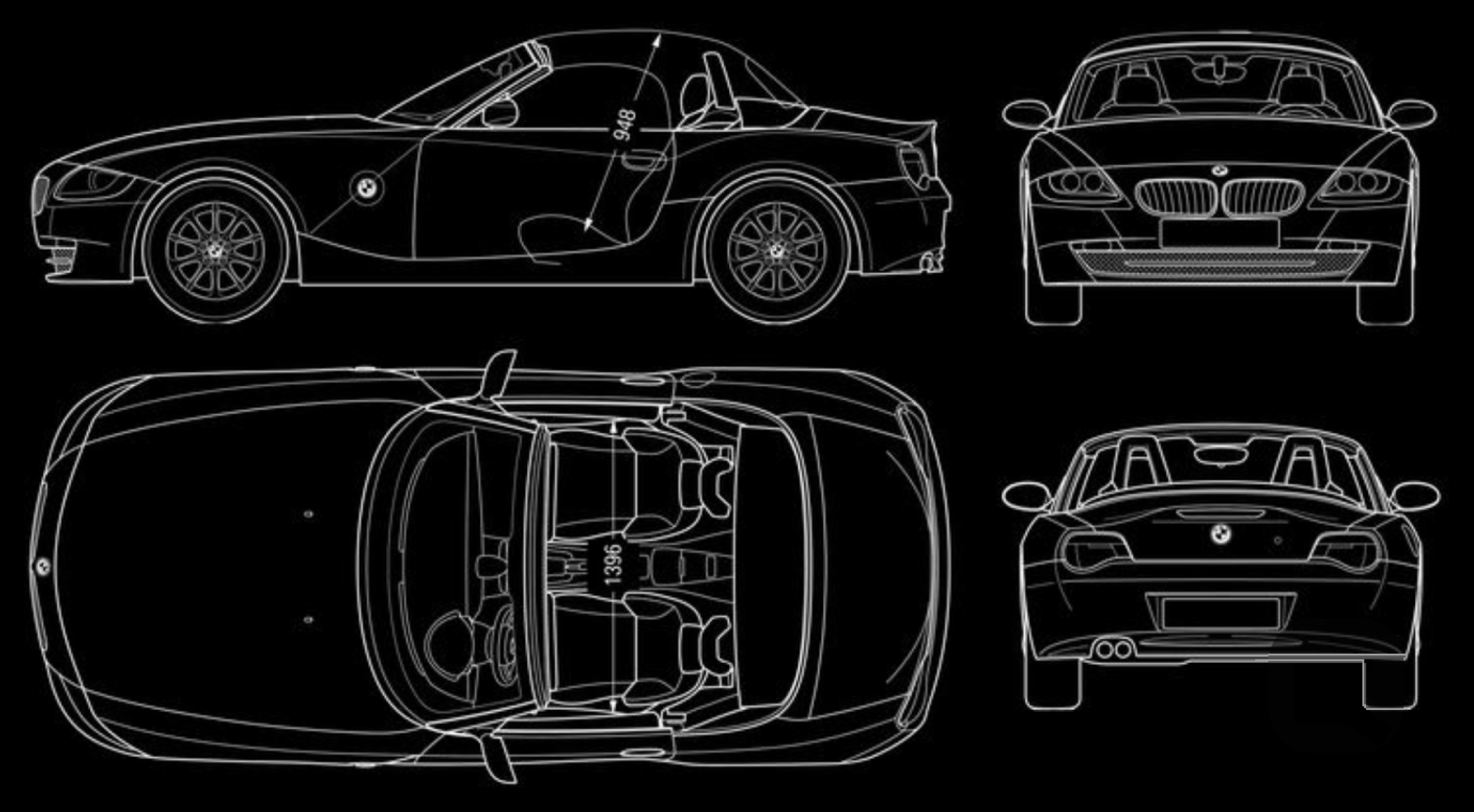
The soft top mechanism is manual on the pre-facelift cars and power-assisted on the facelift. The body is low and wide, with a 98.2-inch wheelbase that's longer than the Z3's, and a stance that sits the driver noticeably closer to the road. Trunk space was modest, but considered a plus for small, convertible sports car. Run-flat tires were standard, which eliminated the need for a spare, freeing up that space entirely. Many modern drivers have replaced the run-flats for a softer ride.
//NEXT// Z4 ROADSTER
E86 Coupe
The coupe arrived later, and it tells a different story.
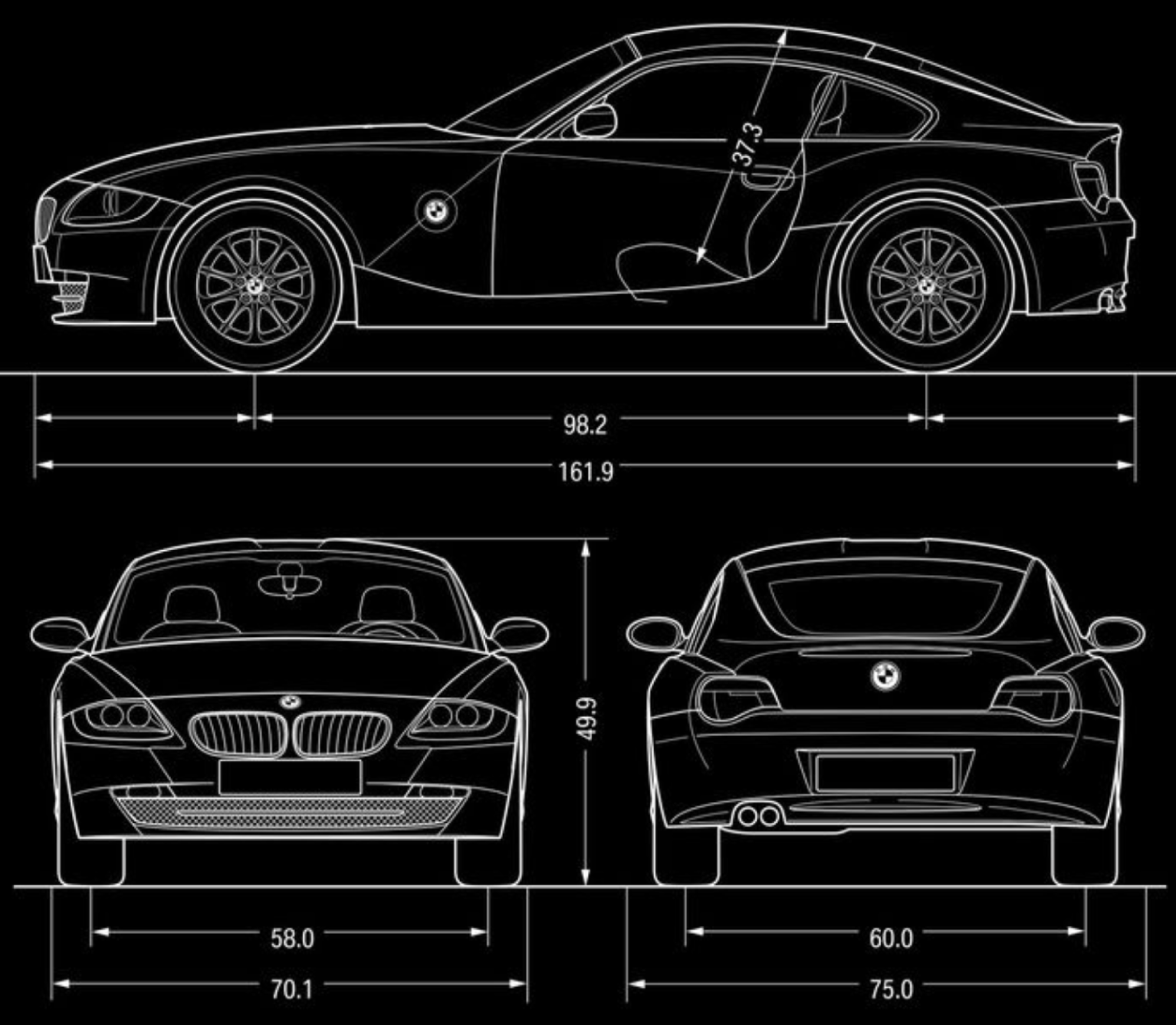
BMW showed the E86 concept at the 2005 Frankfurt Motor Show. The production version debuted at the New York Auto Show in April 2006 and went on sale in late May of that year, three years into the E85's run. Tomasz Sycha designed the coupe so it wasn’t just the E85 with a roof on it. It was conceived and executed as its own thing, though it shares many parts with the E85.
The fixed roof brings a structural benefit that's difficult to overstate. Torsional rigidity on the E86 is more than double the roadster's. For a driver who cares about turn-in precision and chassis feel, this is the only argument needed to justify the coupe, even though the aesthetics, drag, and other factors tell a broader story.
//NEXT// THE COUPE
The roof itself has a double-bubble contour — a nod to classic racing cars, and a practical solution that provides more headroom than the roadster with the soft top raised. The rear glass flows into a fastback that terminates in an integrated spoiler, shaped to generate downforce at speed. Trunk space grows to 10.1 cubic feet over the roadster's 8.5, thanks to the hatch design.
The trim levels for the coupe is deliberately narrow: 3.0si and Z4 M only. There's no entry-level E86, no four-cylinder option, no 2.5i. BMW positioned the coupe as a driver's car from the start, and the trim lineup reflects that. In its first thirteen months on sale, roadsters outsold the coupe at a ratio of seven to one. But by the end of production, just 17,094 coupes had been built worldwide — compared to 180,856 roadsters. The coupe was always the rarer car, and still is.
Z4 Design
The E85's design history is more complicated than most people realize, and the credit has been genuinely disputed.
Anders Warming, a Danish designer who joined BMW in the late 1990s, drew the roadster from mid-1998 to the summer of 1999. The design was frozen on March 1, 2000 — meaning the car that debuted at Paris in 2002 had been locked for over two years before anyone outside BMW saw it. Warming would later return to the Z4 story: he also designed the Concept Coupé Mille Miglia that BMW showed at the 2006 Mille Miglia rally. The E86 production coupe, however, was drawn by Tomasz Sycha.

Where it gets complicated is the broader attribution. The E85 appeared during the Chris Bangle era at BMW, when "flame surfacing" — a design language defined by taut, convex panels interrupted by sharp creases — was reshaping every car the company made. Bangle, as Head of Design, shaped the overall direction. Adrian van Hooydonk, who would later succeed Bangle, also had influence. The result is a car that's unmistakably of its era, but whose authorship sits somewhere in a committee — which is not unusual for production vehicles, but is worth understanding when you hear people say "Warming designed the Z4."
What isn't disputed is the intent. The E85 was meant to be lower, wider, and more aggressive than the Z3 it replaced, while keeping the long-hood-short-tail proportions that define a classic roadster. The aluminum hood and magnesium roof frame were functional choices that reduced weight — but they also contributed to the car's proportions and the way it catches light. The design was polarizing at launch. It is considerably less polarizing now since it helped create the future.
The First Generation Facelift That Was More Than a Facelift
The E85/E86 ran from 2003 to 2008 across two distinct phases. BMW calls its mid-cycle refreshes LCI — Lebenszyklus-Impuls, or "lifecycle impulse." The E85/E86 LCI arrived for the 2006 model year and changed more than just the lights.
Pre-Facelift (2003–2005)
The pre-facelift covers the first three model years of E85 production and is roadster-only — the coupe did not yet exist. Engines are from the M54 family: the 2.2i, 2.5i, and 3.0i. These are the last truly analog versions of the car, before BMW introduced the "si" designations and the N52 engine family. Transmission choices include a five-speed manual on lower trims, a five-speed automatic, and the SMG-II automated manual on the 2.5i and 3.0i.
The pre-facelift is identifiable by its rounder headlight treatment and smoother front fascia. For buyers, it represents the most affordable entry point into the E85/E86 family — and the one with the most character-rich engine in the 3.0i form, which many owners prefer to the facelift's N52.
LCI Facelift (2006–2008)
BMW launched the LCI at the 2006 North American International Auto Show in Detroit, and the changes were substantial enough to make the facelift feel like a meaningful evolution rather than a cosmetic update.
The headline additions: the E86 coupe arrived, the Z4 M variants (roadster and coupe) were introduced, and the six-cylinder engines across the non-M range were upgraded from the M54 to the N52. The 2.2i model was discontinued. New "si" variants — the 2.5si and 3.0si — sat above the standard models with more power and more equipment. The six-speed manual became standard across all trims. The six-speed automatic (ZF 6HP19) became available for the first time. Revised headlights, a reworked front bumper, and updated taillights updated the exterior.
For the coupe specifically, the LCI is the only option — the E86 only ever existed in facelift form.
The Z4 M
The Z4 M is in a category of its own.
Introduced with the 2006 facelift in both roadster and coupe body styles, the Z4 M is powered by the S54B32 - the same 3.2-liter naturally aspirated straight-six that powered the E46 M3. The S54 appeared on Ward's 10 Best Engines list four years running (2001–2004), and BMW's decision to put it in the Z4 with “proper” M-division treatment was not subtle
In North American specification, the Z4 M produces 338 hp at 7,900 rpm. European markets received 343 hp - the same output as the M3. Torque is 269 lb·ft, available from 2,500 rpm. The engine revs to nearly 8,000 rpm and sounds extraordinary doing it.
Among the strengths of the Z4 M and distinctions from the rest of the range are its steering and chassis setup. While every other E85/E86 model uses electric power steering, the Z4 M retains a hydraulic rack - the E46 M3 unit on the roadster, the quicker M3 CS/CSL rack on the coupe. The hydraulic steering unit is consistently described as more communicative, and the Z4 M's steering in particular has become one of its most praised attributes. The brakes and complete rear axle assembly came from the M3 CS/CSL as well. Front track is wider, suspension geometry is revised, and non-run-flat tires (225/45 front, 255/40 rear) replace the run-flats found elsewhere in the range.
The Z4 M was only available with a six-speed manual. There was no automatic option, no SMG.
M Coupe production began at the Spartanburg plant on April 4, 2006. By the end of the generation, 5,070 Z4 M Roadsters had been produced worldwide (3,042 for North America), alongside 4,275 Z4 M Coupes. These numbers put both variants in genuinely scarce territory. Market values have grown accordingly.
//NEXT// MORE Z4 M